
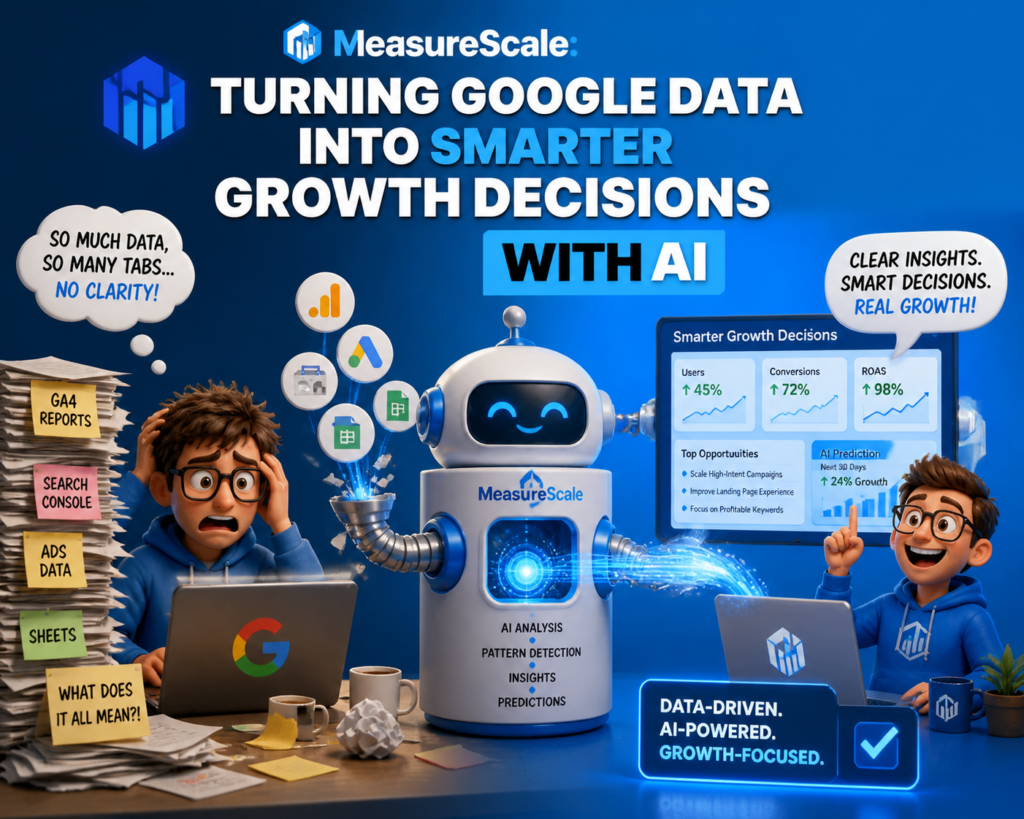
Some companies have Google Analytics, Google Search Console, Google Ads, Looker Studio, beautiful dashboards, spreadsheets, and still make decisions by gut feeling. It is almost poetic. Also quite expensive.
MeasureScale starts from a very specific idea: Google data should not stay trapped in pretty charts reviewed on Monday mornings. It should help you decide which campaigns to stop, which content to reinforce, which funnels are leaking money, and where real growth is happening. This is where artificial intelligence comes in, not as a magic wand, but as a layer for reading, interpreting, and prioritizing.
Because having data is not the same as having judgment. That is worth repeating, especially in meetings where someone opens a dashboard with 47 metrics and nobody knows exactly what to do next.
The problem is not lack of data, it is noise
For years we sold the idea that measuring everything was the solution. Visits, clicks, impressions, conversions, scroll depth, events, forms, calls, abandoned carts, internal searches, and even mouse movement if someone lets us. And yes, measurement is necessary. But measuring without context becomes a kind of analytical karaoke: lots of activity, little value.
In real projects, especially with WordPress, WooCommerce, or custom Laravel platforms, the same issue keeps appearing. The client has plenty of data but does not know which data matters. An ecommerce business may see organic traffic going up while missing the fact that mobile conversion is dropping because of a slow checkout. A B2B company may brag about leads and later discover that 70% of them do not match its ideal customer profile. A local business may keep spending on Ads while ignoring that its Google Business Profile generates more calls than the website.
That is where a tool like MeasureScale makes sense: not to add another panel to the collection, but to reduce noise and turn scattered Google data into actionable decisions.
What MeasureScale should do well to be genuinely useful
The promise of turning Google data into AI-powered growth sounds good. But as a developer, I have already seen too many tools promising “smart insights” only to tell you that “traffic is down 12%”. Thanks, Sherlock, I could already see that in the chart.
For MeasureScale to deliver real value, it should go beyond summarizing metrics. The usefulness lies in detecting relationships, anomalies, and opportunities that are usually lost between tabs.
- Connect Google Analytics, Search Console, and paid campaign data without forcing the user to become a senior analyst.
- Detect traffic drops and link them to pages, queries, devices, or technical changes.
- Prioritize SEO opportunities based on potential impact, not only search volume.
- Translate metrics into tasks: improve a landing page, review indexing, adjust campaigns, fix speed, or reinforce content.
- Explain the reasoning behind each recommendation, because an AI that does not justify its conclusions is basically an intern with too much confidence.
And there is an important difference here: this is not about replacing the consultant, the developer, or the marketing team. It is about removing mechanical work and helping them see what matters sooner.
Google data, AI, and business decisions: a delicate mix
Artificial intelligence applied to analytics has huge potential, but also an obvious risk: producing convincing explanations based on poorly configured data. And that is more common than it should be.
I have seen Analytics setups duplicating events, conversions configured as thank-you pages anyone could reload, campaigns with broken UTM parameters, and forms that had not been sending data for weeks. Then someone connects an AI tool and expects divine revelation. Bad news: if you feed the system garbage, you will get garbage with excellent wording.
That is why, before talking about intelligent growth, we need to talk about reasonably clean data. In WordPress, for example, this means reviewing tags, events, forms, cookies, consent, performance, and mobile behavior. I once wrote about how to check whether your WordPress SEO is actually working, and the idea fits perfectly here: it is not enough to look at numbers, you need to know whether those numbers represent reality.
AI does not fix broken measurement. It only makes the report of broken measurement look more elegant.
The difference between reporting and deciding
A traditional report tells you what happened. A good intelligence layer should help you decide what to do now.
For example, it is not the same to read “page X has lost organic traffic” as receiving an explanation such as: “page X has lost impressions for transactional queries, matching a drop in average mobile position, while competing content has updated price comparisons.” The first sentence informs. The second opens a line of work.
Applied to companies, this changes meetings a lot. Instead of discussing whether “the website is doing well or badly”, teams can talk about specific priorities:
- Which pages generate business and deserve maintenance.
- Which campaigns consume budget without clear return.
- Which searches show purchase intent.
- Which content attracts curious traffic but not customers.
- Which technical issues are affecting conversions.
In ecommerce projects, this kind of reading is especially useful. If you work with WooCommerce, it is not enough to know how many visits arrive. You need to know whether those visits reach products, add to cart, abandon because of shipping costs, or get lost because the internal search looks like it was designed during detention. To go deeper into that topic, it makes sense to connect this with strategies like the ones I discussed in how to scale a WooCommerce store without breaking the business.
Why developers should care too
Many developers find analytics boring. Fair enough. We spend our time fixing bugs, deploying code, fighting APIs, optimizing SQL queries, and explaining why “just changing a button” is not always five minutes. But business data should matter to us more than we admit.
When a developer understands which pages convert, which forms fail, which routes create friction, or which campaigns bring useless users, they start building better software. Not prettier. Better.
If properly designed, MeasureScale can act as a bridge between marketing and development. It can point out that a conversion drop does not come from “the campaign”, but from a JavaScript error in Safari. Or that a landing page is not failing because of copy, but because it loads 6 MB of unoptimized images. Or that a B2B form loses leads because it asks for too much before earning trust.
And this is not theory. In web maintenance, you see it constantly. A plugin update breaks an event. A theme change removes structured data. A poorly closed migration leaves important URLs outside the index. That is why it also makes sense to read about how to check WordPress SEO after migrating a domain, because many growth decisions begin by not breaking what was already working.
Automation does not mean turning your brain off
The most interesting part of a tool like this is not only the analysis, but what it can trigger afterward. Alerts, automated tasks, weekly summaries, technical notifications, content suggestions, detection of inefficient campaigns, or CRM integrations.
This is where workflows with tools like n8n, integrations with Dolibarr, or even internal systems built in Laravel come into play. If MeasureScale detects that a campaign generates high-quality leads, that information should end up in the CRM. If it detects that a strategic URL is losing visibility, a task should be created. If a campaign exceeds a certain cost without conversions, someone should receive an alert before burning the monthly budget.
I have talked before about how to get the most out of n8n, and this kind of tool fits very well with that philosophy: automate the repetitive work, but leave important decisions to people with judgment.
Good automation does not replace the team. It prevents the team from chasing weak signals for hours.
What I would check before trusting MeasureScale
If a company asked me whether it should use MeasureScale, I would not start with the pretty demo. I would start with less glamorous questions:
- Which Google sources does it actually connect?
- How does it handle permissions and data privacy?
- Can users audit where recommendations come from?
- Does it distinguish correlation from causation, or does it get carried away too quickly?
- Can it integrate with real work tools: CRM, task managers, Slack, email, ERP?
- Does it work for small teams or only for departments with dedicated analysts?
Transparency is key here. A recommendation like “invest more in this campaign” without explaining the reasoning is not enough. I need to know whether it is talking about real conversions, lead value, margin, attribution, or simply cheap clicks. Cheap clicks are like cheap furniture: they seem like a good idea at first, until they start wobbling.
AI for growth, but with feet on the ground
Intelligent growth does not come from a button. It comes from combining good measurement, useful technology, business knowledge, and enough discipline not to chase every shiny metric on the screen.
MeasureScale points to a real need: turning Google’s data ecosystem into clearer decisions. That has value for agencies, online stores, B2B companies, local businesses, and technical teams that need to prioritize without spending half their life comparing reports.
But the key will be how it does it. If it stays at pretty summaries, it will become yet another tool in the “we tried it and then nobody opened it again” folder. If it manages to explain, prioritize, and connect data with concrete actions, it could become an interesting piece in a company’s growth stack.
Conclusion: fewer dashboards, better decisions
Companies do not need more screens full of metrics. They need to understand what is happening, why it is happening, and what to do next.
MeasureScale enters a space full of promise and a fair amount of smoke, but also a huge opportunity: making Google data stop being a historical archive and become a daily decision-making tool.
My opinion is simple: if AI helps people think better, welcome. If it only decorates reports, it is unnecessary. Growth does not come from staring seriously at dashboards. It comes from making better decisions before everyone else.