
If you’ve been working with WordPress for a while, you know one uncomfortable truth: when things get serious, the API starts to struggle.
Complex filters, advanced searches, multi-parameter queries… and suddenly you’re either stuffing half a JSON into a URL or using POST for something that should clearly be a GET request.
This is where HTTP QUERY (RFC 10008) comes in.
And yes, its impact is bigger than it looks, especially once you start scaling real WordPress or WooCommerce architectures.
The real problem in WordPress
WordPress has two worlds:
- REST API (wp-json)
- WP_Query (the real query engine behind the scenes)
And the bridge between them has never been perfect.
In theory, the REST API should abstract data access cleanly. In practice, you often end up rebuilding WP_Query logic inside custom endpoints.
This creates a structural issue: logic duplication and loss of core-level optimization.
If you’ve worked with scaling WooCommerce projects, this problem becomes even more obvious:
Scaling WooCommerce properly in WordPress
Typical case
You need to run an advanced post search:
- multiple taxonomies
- date ranges
- complex meta_query conditions
- dynamic sorting
Typical result:
POST /wp-json/custom/v1/search
👉 It works.
👉 But it introduces technical debt over time.
The issue is not just semantic: you’re misusing HTTP methods, which impacts caching layers, CDNs, and proxies.
This type of problem also appears in technical SEO audits in WordPress:
WordPress technical SEO validation
What changes with QUERY
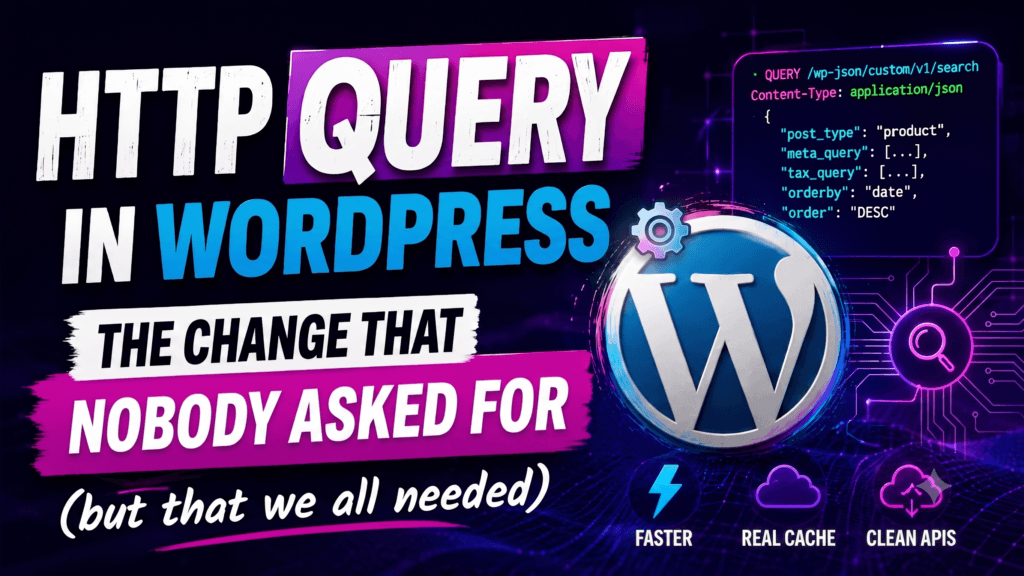
QUERY /wp-json/custom/v1/search
Content-Type: application/json
- still read-only
- cacheable by design
- HTTP semantics are respected properly
- avoids misuse of POST for data retrieval
This is not just a syntactic change — it’s an architectural shift.
At scale, this allows queries to be pushed closer to the edge (CDNs, workers) without breaking consistency.
Real impact (not theory)
1. Massive caching improvements
The biggest win is being able to cache complex queries as real GET-like resources.
This reduces database load and improves response times in WooCommerce or large catalogs.
WordPress performance optimization
2. Cleaner and more maintainable APIs
POST /filter-products
becomes:
QUERY /products
This improves not just readability, but also long-term API evolution and client compatibility.
3. Better fit for Headless WordPress
In headless setups (Next.js, Nuxt, Astro), the challenge is not just fetching data, but doing it efficiently without hacks.
QUERY allows complex filtering without turning URLs into unmaintainable monsters.
Modern web architecture and UX patterns
The problem: WordPress is not ready yet
As of today:
- WordPress core does not support QUERY
- REST API does not implement it
- most plugins ignore it completely
This means adoption requires an abstraction layer.
How to start (in practice)
Option 1: Middleware (recommended)
Intercept QUERY requests and translate them into POST internally while preserving clean external semantics.
Option 2: Custom plugin
Extend the REST API to support QUERY and map it directly to WP_Query.
Option 3: API Gateway
Use tools like Cloudflare Workers, Kong, or Traefik to normalize requests before they hit WordPress.
Is it worth it today?
Yes, if:
- you run large WooCommerce stores
- you use headless WordPress
- you have performance or caching issues
WooCommerce scalability strategies
No urgency, if:
- you run a simple corporate website
- you rely on basic REST usage
Conclusion
HTTP QUERY is not a trend or a cosmetic improvement.
It’s a response to a structural limitation in how WordPress has historically handled data retrieval through APIs.
For years, we’ve normalized using POST for complex read operations.
QUERY proposes restoring semantic correctness to that design.
And although it is not part of WordPress today, its impact becomes clear in real-world systems where performance, caching, and scalability actually matter.